

Chitin was discovered by French scholar Braqueno in 1811 and extracted from crustacean shells by Ogier in 1823 and named CHITIN. Appearance and properties: light beige to white.
Chitin is a practical product and the first "functional food" approved in Japan. However, chitin is insoluble in water, alkali, general acid and organic solvents, and only soluble in some concentrated acids. It is partially decomposed by the action of chitinase and lysozyme in the human gastrointestinal tract. Therefore, its absorption rate is extremely low, the dosage is large, and the reaction to taking is as high as more than 70%. Chemical treatment of chitin, removing the acetyl group, becomes chitosan.
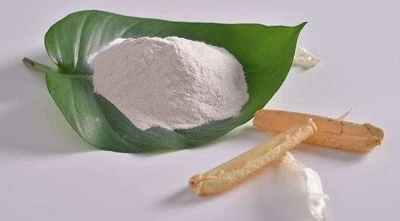
Chemical name: polyglucosamine (1-4)-2-amino-B-D glucose
Molecular formula and molecular weight: (C8H13NO5)n
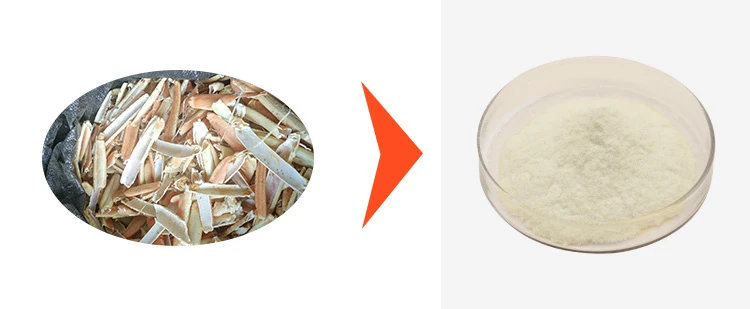
Chitosan, chemically known as polyglucosamine (1-4)-2-amino-B-D glucose, is obtained by deacetylation of chitin. Generally speaking, chitosan is obtained when more than 55% of the N-acetyl groups are removed. Chitosan is already soluble in dilute acid, which is a step forward from chitin. However, both chitin and chitosan are large molecules with molecular weights ranging from hundreds of thousands to millions, and are insoluble in water. Chitosan is obtained by deacetylation of chitin, and then further degraded to become chitosan oligosaccharides.
Chemical name: -(1→4)-2-acetylamino-2-deoxy-D-glucose
Molecular formula and molecular weight: (C8H13NO5)n
Using chitosan as a raw material, degrading chitosan into small molecules is chitosan oligosaccharide. Its molecular weight is about 3000Da, and the degree of polymerization is 2-20. Therefore, chitosan oligosaccharide itself is a mixture, which contains monosaccharides all the way to chitosan decasaccharides, and each type of sugar has its own certain functionality.
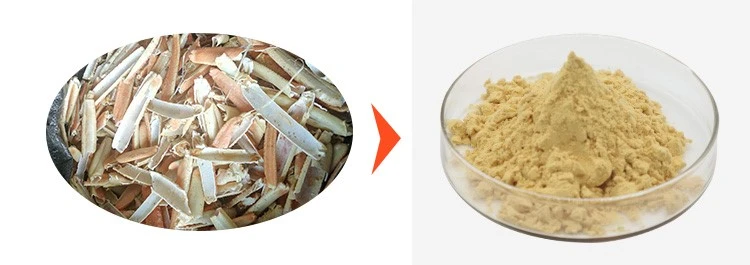
Chitosan oligosaccharides can be directly dissolved in water, with a water solubility of more than 99%, and a human absorption rate of 99.88%. The dosage and reaction after taking are greatly reduced, and the direct physiological regulation effect of participating in the human body is more significant than chitosan, and it has many functions superior to high molecular weight chitosan. Chitosan must be degraded by the human body's biological enzymes to obtain some small molecular weight chitosan oligosaccharides. Under normal circumstances, the degradation ratio is 1-5%, and the remaining 95% of the polysaccharides are eliminated through the human intestinal system. Therefore, chitosan oligosaccharides are more effective in increasing the body's immune function than chitosan.
01. Molecular weight difference
Chitosan oligosaccharides are a new product obtained by treating chitosan with special bio-enzyme technology, with a molecular weight below 3000Da; chitosan is a product of partial deacetylation of chitin, with a molecular weight of 500,000-1 million.
02. Solubility difference
03. Functional difference
Chitosan oligosaccharides with a molecular weight below 2000 show unique physiological activities and functions: improving the function of macrophages; inhibiting the growth and metastasis of tumor cells; reducing cholesterol and blood lipids; antibacterial, antibacterial and significant moisturizing and hygroscopicity, etc.
Chitosan oligosaccharides with a molecular weight below 5000 have the ability to hinder the growth and reproduction of pathogens, promote protein synthesis, and activate plant cells, thereby promoting rapid plant growth.
The premise for chitosan oligosaccharides to be absorbed by the intestines is that they are not digested by digestive enzymes. Chitosan oligosaccharides are polymers formed by glucosamine connected by -1,4-glycosidic bonds, and the digestive enzymes in the human gastrointestinal tract mainly act on -1,4-glycosidic bonds, so chitosan oligosaccharides can maintain structural integrity in the gastrointestinal tract.